Client-area design
Create or customise client-area themes and order-form templates around your brand and user journeys.


WHMCS is the billing and client-management platform this service addresses. We help hosting businesses review its customer-facing design and supported integration workflows, from client-area presentation to module requirements, with development scoped against the actual installation.

WHMCS is a client management, billing and support platform used by hosting businesses. Our development service adapts its supported extension points to your brand and operational requirements; it is separate from the WHMCS software licence.
Include your WHMCS version, theme, installed modules, target workflow and any provider API documentation. Use agreed secure access arrangements; do not put credentials in the initial brief.
The proposal defines which of these capabilities are included in your project.
Create or customise client-area themes and order-form templates around your brand and user journeys.
Build scoped administrative or client-area features through the supported addon module approach.
Use documented hooks to respond to application events without treating core-file changes as the default.
Connect external applications with supported APIs, defined permissions and clear error handling.
Scope service-provisioning, registrar or gateway module work against the relevant interface and provider documentation.
Review the target installation and dependencies, test agreed journeys and document the delivered customisation.
WHMCS brings these functions into a hosting-business platform. Custom development adapts supported themes, modules, hooks and APIs to your requirements.
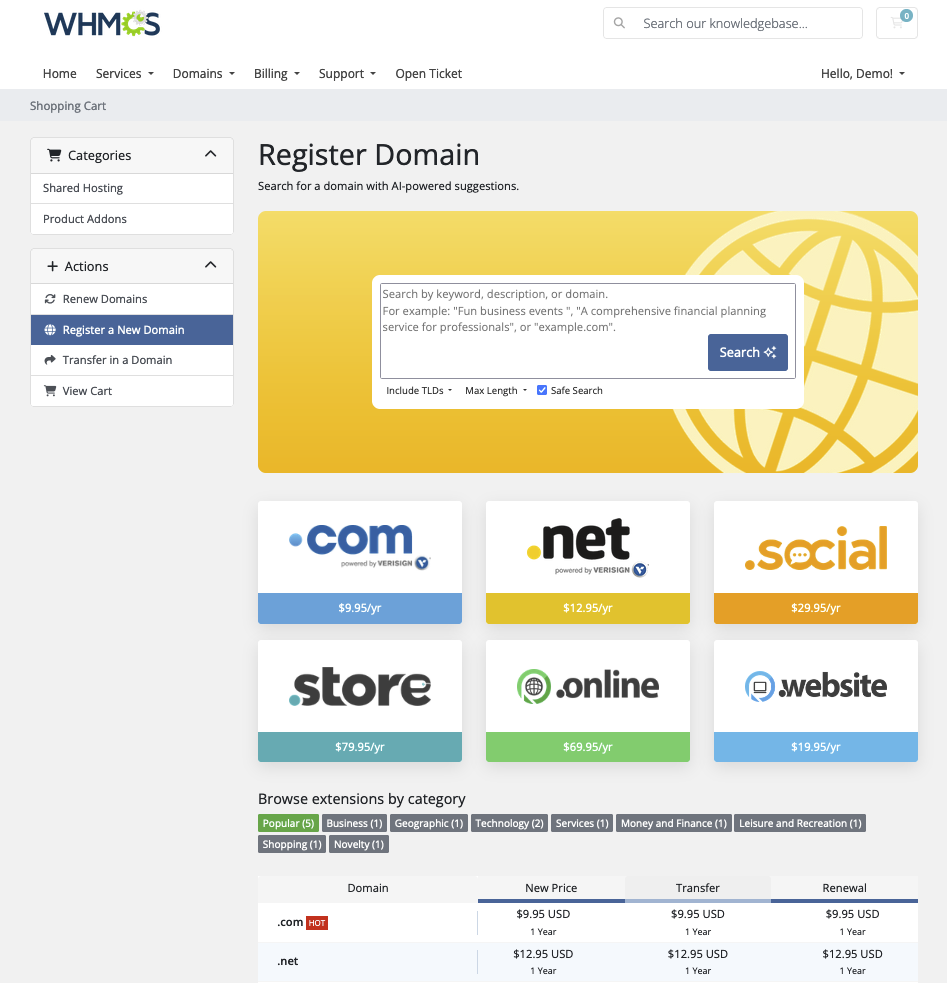
WHMCS provides the underlying application. Bazecity scopes the design, customisation and integration work around your installation, its version and its licensed components.
Your project brief should identify the customer journey or operational task to improve. We review dependencies before confirming the implementation approach.
WHMCS and its product imagery belong to their respective owner. No official affiliation or endorsement is claimed.
Deliverables and acceptance criteria are agreed in writing before implementation.
Review the requirement, agree the scope and test the work against the outcome.
Review the current setup, users, dependencies and practical constraints.
Implement the agreed work with useful review points and recorded decisions.
Check the main journeys and document the delivered configuration and responsibilities.
Use these answers as a starting point, then bring your project-specific requirements into the brief.
Yes. This service is specifically for WHMCS, the client management, billing and support platform used by hosting businesses. Bazecity provides development and customisation services around that platform.
Only if a licence is explicitly included in the written proposal. Development work, third-party modules, software licensing and recurring vendor charges are otherwise separate.
We review its licence, supported extension points, source availability and compatibility before agreeing the work. Some third-party products restrict modification.
No blanket compatibility promise is made. The target version and dependencies are recorded, and the agreed changes are tested against that environment. Future upgrades may require further review.
This page describes Bazecity’s development service. WHMCS is a third-party platform; no official partnership, certification or endorsement is claimed.
A clear starting point is enough: your current setup, the task you want to improve and the outcome you need.
BAZECITY UK
Identify the WHMCS version, active theme, essential modules and the workflow you want to improve. A customer ordering a service, viewing an invoice or contacting support encounters different parts of the system. Map the steps and the relevant configuration so a design or development proposal addresses the real setup rather than a generic dashboard image.
Review custom work in an appropriate test environment and define acceptance around the agreed customer actions. Identify which changes belong in a theme, a supported module or a separate integration. The scope should also describe handover and compatibility review for future updates; a visual redesign does not establish a new billing, payment or tax capability.